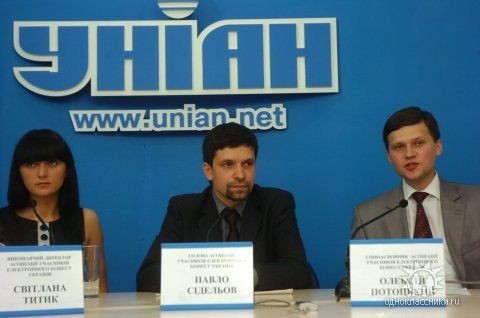
In June 2008, years before Ukraine had a law on electronic commerce, I co-founded the Association of Participants of Electronic Business of Ukraine: a non-governmental industry association created to unite, represent and advocate for the interests of e-commerce participants across the country. For 3 years and 4 months, until 2011, I served on the Management Board and was active in all parts of its work: setting strategic direction, taking part in conferences and government dialogue, representing the industry at press conferences at UNIAN, one of Ukraine’s largest news agencies, and giving interviews on national business television. The founding press conference was documented by UNIAN, with my name in the official photo record.
- 2008the Association was founded, seven years before Ukraine’s law on electronic commerce
- UNIANfounding press conference on 4 June 2008, in UNIAN’s photo archive with my name
- National TVinterview on First Business Channel, a national business TV channel in Kyiv
- My role
- Co-Founder, Management Board member
- Organisation
- Association of Participants of Electronic Business of Ukraine
- Type
- Non-governmental industry association
- Founded
- 4 June 2008, Kyiv, Ukraine
- Visibility
- UNIAN, First Business Channel, national conferences with government agencies
- Period
- 2008 to 2011, 3 years 4 months
The challenge
Ukraine’s e-commerce sector in 2008 was growing fast, but it had no dedicated legal framework, no industry standards and no unified representation. Online businesses had no collective voice in policy dialogue with government, and there were no consumer protection rules written for online purchases.
Ukraine had laws on electronic documents and electronic digital signatures from 2003, but its Law on Electronic Commerce was adopted only in September 2015, seven years after the Association was founded. Until then there were no rules written for electronic contracts or online shops. Industry associations like this one were the main way the sector could talk to government about the legal environment it would one day work in.
Industry associations in a young market do things that individual companies can’t. They make the sector legitimate in the eyes of government and the public, open a dialogue channel with regulators, and build the shared standards and practices that let the market grow safely.
My task: as co-founder and Management Board member, help build the Association and represent e-commerce participants in public, in the media and in dialogue with government.
How was e-commerce regulated in Ukraine before 2015?
From 2003, Ukraine had a law on electronic documents and electronic document flow (No. 851-IV) and a law on electronic digital signatures. Online shops also worked under the general civil, commercial and consumer protection laws, which were not written for the internet. The Law of Ukraine “On Electronic Commerce” (No. 675-VIII) was adopted on 3 September 2015 and came into force on 30 September 2015. It defined electronic transactions and how they are made and signed, and it requires online sellers to show who they are: name, address, registration number, contact details, and whether prices include taxes and delivery.
What I did
-
Co-founded the Association and set its strategic direction
I co-founded the Association of Participants of Electronic Business of Ukraine and served on the Management Board. This meant establishing the founding mandate, defining the Association’s policy positions, identifying the issues of e-commerce participants that needed collective representation, and building the governance structure that let the Association act credibly with government agencies and other stakeholders.
-
Announced the founding at a UNIAN press conference in Kyiv
I was a speaker at the founding press conference at UNIAN’s press centre in Kyiv, a main venue for national media events. The press conference, “Foundation of the Association of Participants of Electronic Business of Ukraine”, was documented in UNIAN’s photo archive with my name next to the other founding participants. This gave the Association a public record at national level from its first day.
-
Represented the sector on national business television
I gave a personal interview on First Business Channel, a national business TV channel in Kyiv. The channel closed on 1 February 2023, and its YouTube channel is still online. A television interview is a different platform from a press conference: a longer, recorded and named statement of the Association’s position and the e-commerce sector’s interests to a national business audience.
-
Spoke at conferences with government agencies and C-level executives
I served in the presidium of several industry conferences that brought together Ukrainian government agencies and C-level executives from the private sector. In those years these conferences were the main place to shape regulatory and policy expectations: consumer protection, payment infrastructure, tax treatment of online commerce and cross-border trade. Representing the Association there meant translating the technical and commercial realities of e-commerce into policy language that government participants could act on.
-
Advocated for e-commerce participants in every public forum
In member meetings, industry events, press conferences and the media, I advocated for the interests of Ukrainian e-commerce participants: clear and fair rules, consumer protection that built trust without stopping market growth, payment infrastructure for digital transactions, and recognition of digital business as a growing sector of the economy. Some of these questions, such as electronic contracts and what online sellers must tell buyers, were later answered by the Law on Electronic Commerce in 2015.
Results
From 2008 to 2011, the work delivered:
- A national industry association for e-commerce participants, founded in June 2008 with a mandate, policy positions and a governance structure.
- A public record from the first day: the founding press conference at UNIAN, documented in its photo archive.
- The sector’s voice on national business television and at conferences with government agencies and private sector C-level executives.
- Steady advocacy for clear and fair rules, consumer trust, payment infrastructure and the recognition of digital business as its own sector of the economy.
What I learned
Markets don’t regulate themselves, and they don’t advocate for themselves.
Ukraine’s e-commerce sector grew quickly for years without a dedicated law or a unified industry voice, in an environment where a single regulatory mistake could have hurt it badly. Industry associations are the infrastructure that prevents that, and they have to be built before a crisis. The most important contributions to a market often happen years before they become visible: the law came in 2015, after years of dialogue between the industry and government. Being credible in a government forum or on national television also needs the same depth of understanding as being credible in an architecture board. Only the audience and the stakes are different.
Evidence and further reading
- Photo record · UNIANFounding of the Association of Participants of Electronic Business of UkraineThe founding press conference, 4 June 2008, with my name in the captions.
- Video · YouTubeFirst Business ChannelThe channel’s archive on YouTube. The TV channel itself closed on 1 February 2023.
- Related projectFrom developer to CEO: building a Ukrainian web studioThe web studio I led, including its work for the e-commerce CRM market.
- Related projectFounder of Topping, a web statistics platform built from scratchAnother early project in Ukraine’s internet economy.
The 2015 law’s adoption, signing and publication dates are in the DTKT news report (in Ukrainian).
Skills and technologies
- Industry association leadership
- Co-founder
- Management Board governance
- E-commerce policy
- Government relations
- Policy advocacy
- Regulatory dialogue
- Public speaking
- Media relations
- Press conferences
- TV interviews
- Stakeholder engagement
- Digital economy
- Strategic direction
Let’s discuss your project and goals
Are you building something that needs industry leadership, policy engagement or advocacy alongside technical and delivery work? In 30 minutes we can look at whether your challenge is technical, organisational, regulatory or a mix of all three, and what kind of leadership it needs.
- You’re building a new market, product category or industry segment
- You need leadership experience that includes policy and government engagement
- In your market, the regulatory environment is a competitive factor
- You’re building or scaling a digital business in an emerging market
No sales pitch, just a direct conversation about your goals and constraints.